Pujo Gyan
Pujo Words: A Durga Puja Glossary
New to Pujo, or explaining it to a friend? These are the words you will hear in every pandal.
A
- Adda
- Long, lazy, passionate conversation with friends, a Bengali art form at its peak during Pujo.
- Agamani
- Songs of the goddess's arrival, sung from the mother Menaka's point of view.
- Alpana
- Floor designs drawn with rice paste, especially for Lakshmi Puja.
- Anjali (pushpanjali)
- Offering flowers to the goddess while repeating mantras after the priest, most of all on Ashtami morning.
- Arati
- Worship with lamps, incense, conch, flowers and a yak-tail fan, waved before the goddess to the dhak.
B
- Bhog
- Food offered to the goddess and then shared as prasad: khichuri, labra, beguni, chutney, payesh.
- Bijoya
- The greetings after immersion: pronam to elders, hugs, sweets and 'Shubho Bijoya'.
- Bisarjan
- Immersing the idol in a river or pond on Dashami (or later), ending the Puja.
- Bodhon
- The 'awakening' of the goddess on Shashthi evening at a bel tree.
- Bonedi bari
- Old aristocratic family homes with their own centuries-old pujas.
- Boron dala
- The tray used by married women to bid the goddess farewell: sindoor, paan, sweets, lamp, conch bangles.
C
- Chalchitra
- The painted arch behind the idols.
- Chandi path
- Recitation of the Devi Mahatmya, the scripture of the goddess.
D
- Dhak
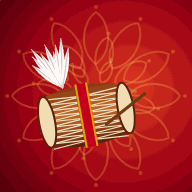
- The big barrel drum of Durga Puja, slung from the shoulder and played with two thin sticks, decorated with white feathers.
- Dhaki
- A dhak player. Many come to the city from villages, gathering at Sealdah station to be hired.
- Dhunuchi
- A clay incense burner filled with coconut husk and dhuno resin; dancing with it is dhunuchi naach.
E
- Ekchala
- All the idols in one single frame.
G
- Ghot
- A sacred water pot, marked with sindoor and topped with mango leaves, in which the goddess is invoked.
K
- Kash phool
- Tall white kans grass that blooms in autumn: the sign that Pujo is near.
- Kasor
- A bronze gong played alongside the dhak.
- Kola Bou
- The Nabapatrika: nine plants bundled and dressed in a sari, placed beside Ganesh.
- Kumari Puja
- Worship of a young girl as the living goddess on Ashtami.
- Kumartuli
- The potters' quarter in north Kolkata where most idols are made.
M
- Mahalaya
- The new moon that begins Devi Paksha, about a week before Pujo.
- Mritshilpi
- A clay sculptor who makes the idols.
P
- Pandal
- The temporary structure, from bamboo and cloth to elaborate art installations, that houses the idol.
- Pandal hopping (thakur dekha)
- Going from pandal to pandal, often all night, to see the idols.
- Para
- Neighbourhood. Every para has its puja, and its pride.
- Pratima
- The idol of the goddess.
- Probashi
- Bengalis living outside Bengal; a probashi puja is one held far from home.
- Pujo
- How Bengalis say 'Puja'. For most, 'Pujo' simply means Durga Puja.
S
- Sandhi Puja
- The 48-minute worship at the junction of Ashtami and Navami, with 108 lotuses and lamps.
- Sarbojanin
- 'For everyone': a community puja funded by the neighbourhood.
- Shankha (shankh)
- The conch, blown at arati and auspicious moments.
- Shola
- Soft white pith used to make the idol's ornaments and crowns.
- Sindoor Khela
- On Dashami, married women smear each other with vermilion after bidding the goddess farewell.
T
- Theme pujo
- A pandal and idol built around an artistic idea, from village crafts to social messages.
- Tithi
- A lunar day. Puja days follow tithis, not calendar dates, which is why a day can span two dates.
U
- Uludhwani (ulu)
- The high, trilling call made by women at auspicious moments.